Silvia Navarro & Diana García in “Labios Rojos” [2011 Mexico]

Rafael Lara’s “Labios Rojos” [Eng. Title: Red Lips] is your stereotypical mainstream comedy about marital woes (predominantly sexual) where the characters are usually caricatures and ridden with cliché. This film might as well have been churned out twenty years ago if you can take away their mobile phones. I suppose there’s always a market for such escapist films which is why they get made. But I believe Lara is a better director than this effort might suggest, and I’ll give him the benefit of the doubt. Aside from the subject, it surprisingly has high production values and at times looks as glossy as a Hollywood film. And I have to admit some scenes are positively hilarious even if we can see the gags coming from a mile away. The other virtues of course are the fine and sexy actresses who feature in it – Diana García and Silvia Navarro – together they more than make up for what is otherwise a pretty average film.

Amazon.com DVD Link


Storyline:
Ricardo and Blanca are blissfully married, and in love. Until Ricardo takes up a new job as an executive at a leading advertising agency. The stress takes its toll when Ricardo discovers his erectile dysfunction, which leads to him giving Blanca excuses for not having sex. Blanca however suspects he may be having an affair and tries all kinds of methods to woo him back, including using the services of a shaman. Ricardo becomes obsessed with sex and thanks to his lecherous pal, he even considers an affair with the horny and very available Violeta, a colleague at work. Will Blanca win Ricardo back before its too late, that’s what the film’s about.


.
Continue reading

Posted in Mexico | Tagged , , , , , , , | 1 Comment

Marcella Braga in “Exit – Una storia personale” [2010 Italy]

Actor Max Amato’s directorial debut, “Exit, Una Storia Personale” [Eng. Title: Exit – A Personal History] is an ambitious film whose storyline holds quite a bit of promise. Whether it realised its potential is another matter.

The topic is as contemporary as can be at a time when people are seriously debating the ethical and moral dilemmas posed by euthanasia. If it is all about ending one’s suffering, how do we determine they’ve reached the limit beyond which allowing them to live would be considered inhumane. And should such suffering qualify only when it is physical. And how much can family and therapy help in curing mental illness. The film tries to address these issues through its protagonist, with some degree of success. Marco has some serious issues bordering on schizophrenia and had been in therapy for the longest at his clinic. His brother Davide tries his best to help even if he finds it hard reigning Marco’s increasingly psychotic behaviour. Marco knows he is ill, and after a fellow patient kills himself by jumping out of the clinic window, he decides to end his life too but as humanely as possible. He travels to Amsterdam for an assisted suicide. Davide and girlfriend Nina follow hoping to find Marco before it is too late. We are left wondering if one can ever be stopped from taking his life, if he thinks it is his human right.

On the whole it is an honest attempt by Amato to address an issue, and since I hate to be overly critical of directors making their cinematic debut, all I’d say is that depite the decent characterisation and interesting story, the film could have done with some additional work on the screenplay.

Amazon DVD Link


.

Continue reading

Posted in Italian Cinema | Tagged , | Leave a comment

Candy Clark & co in “The Man Who Fell to Earth” [1976 UK]

We’re now getting down to the classics of the great Nicolas Roeg. His 1976 drama, “The Man Who Fell to Earth” can be rated as one of the all-time sci-fi classics in cinematic history, proudly occupying the same exalted podium as Fritz Lang’s Metropolis, Stanley Kubrick’s 2001: A Space Odyssey, Andrey Tarkovsky’s Solaris, and George Lucas’ Star Wars trilogy. The film’s uniqueness stems from the ambitious manner in which it dissects contemporary society, politics, and humanity as a whole in a typically European fashion – droll, filled with irony, and approaching it from the protagonist – an extraterrestrial’s viewpoint.


Storyline:
Based on a Walter Tavis novel of the same name, and adapted for screen by Paul Mayersberg, the film tells the story of an extraterrestrial humanoid who arrives on earth to help the few remaining beleaguered people in his home planet, which has turned into one big desert. The reasons for these are not given in the film (even if they go into some detail in the novel), merely stating lack of water as reason for his arrival. His people had known about earth for a while through intercepted radio signals and have come to gain intimate knowledge of its dominant species, humans. The plan is for him to amass wealth and power quickly with his advanced technology, and use it to build a spaceship to bring back the rest of the people, more importantly his wife and two kids. After landing in New Mexico, he assumes the name of Thomas Newton, and interestingly uses a British passport to identify himself. He soon embarks on a love affair with hotel chambermaid Mary-Lou, who also moves in to live with him. But his mind is restless, worrying about his family, and resorts to alcohol. When Mary-Lou discovers his true identity, she finds it extremely hard to love him as before, and despite efforts, they separate.

He succeeds emphatically in building his corporate empire, and also manages to build his spaceship. But the US authorities destroy it and take Newton captive for an undisclosed period of time. The reason for this, apart from the obvious desire to ‘study’ him after learning about his identity, is the fact that they were quite weary of allowing a single corporation to become so powerful as to pose a threat to the very existence of a government (Google, take note). By the time Newton realises he is free again, all the people he knew had aged considerably, while he remains his youthful self. He is still wealthy, but could do nothing with it as he realises his family may no longer even be alive. Despite people betraying him, he could hold no bitterness, even offering to help them financially if needed. He’s now a recording artist releasing songs with cryptic messages, which he hopes will one day be heard by his wife through the radio broadcasts that reach there. And the film ends with a drunk Newton passing off at a restaurant table while chatting with his former employee Bryce


A true masterpiece:
When a creative endeavour cannot be bettered or replicated, either because of an artist’s unique state of mind, or serendipitous circumstances surrounding its creation, in my view, a masterpiece is born. And we are talking about a team of artists here. For a start, no one would even fund a project with such ambitious a scope these days – it is far safer to deploy CGI and work with a simple storyline, one that the impatient masses can sit through. There is so much going on here for a sci-fi film, using a variety of references, from Greek myths (Icarus) to Japanese folk art (Kabuki) and even Citizen Kane, it recreates the disorientation of anyone arriving at an alien planet superbly and shows our world as would be perceived by a visitor, warts and all.

Nic Roeg has a penchant for casting performance artists in films, like Mick Jagger in Performance, and Art Garfunkel in Bad Timing. Here, it’s an already famous David Bowie making a film début, playing the eponymous extraterrestrial who fell to earth. Not only does he look like one, during those heady Ziggy Stardust days he also felt like one, relying on cocaine to keep him going. During the shoot of the film, David Bowie was simply being himself, and what an impact it had on the film..!

The superlative cinematography by Anthony Richmond adds an additional layer to the film’s narrative. Coming from a cinematographic background, Nic Roeg has made the best possible use of widescreen – when I first watched this film, it was on TV during the 80’s (i.e., full-frame), it was a pleasant surprise when I finally got to see it in its original aspect ratio. The editing is crisp with few dissolving transitions – the way I like it, as it reflects on the quality of the screenplay and direction. The film is also supported by a superb soundtrack that also features some sumptuous saxophone compositions by John Phillips that sadly are not available on their own.

It may have a plethora of seemingly lecherous scenes and playful jokes, but it is an unapologetically bleak film, it won’t leave you in tears of joy. But this multi-layered gem speaks the language of anyone who feels alienated, anyone who find the system driving their spirits down. It is a film as relevant today as when it was made, and therefore Highly Recommended Viewing..!


DVD info:
The DVD I have is the excellent 2-disc NTSC Criterion Collection, which comes with a superb remastered transfer and loads of extras, including the paperback version of Walter Tavis’ novel. It may not include an interview with David Bowie himself, but it comes with an insightful commentary from Roeg, screenwriter Mayersberg, and an interesting interview with Candy Clark who plays Mary-Lou. But this edition is out of print now, and the ones being sold are ridiculously expensive. But there’s a recent Blu-ray from Optimum Home Entertainment (although Region 2) which appears promising, but not sure of any of the available extras. You can take a look at some comparisons here.
Amazon Blu-ray Link
Amazon Criterion Collection DVD Box-set Link


.

Compilation: Candy Clark, Linda Hutton, Adrienne Larussa, Hillary Holland, and Claudia Jennings
I’d normally not brag about my compilations, but I must say I’m quite pleased with this one as it all falls in place neatly. It took a while but I think it was worth it.

Candy Clark, Linda Hutton, Adrienne Larussa, Hillary Holland, and Claudia Jennings in The Man Who Fell to Earth.

Candy Clark provides some ‘cutting-edge’ nudity, as does Linda Hutton, Adrienne Larussa, Hillary Holland, and Claudia Jennings in Nicolas Roeg’s sc-fi masterpiece, “The Man Who Fell to Earth”.

Scene Guide:

  • Nathan Bryce (Rip Torn) is your quintessential ‘cliché’ of a scientist, separated from his wife and spending most of his free time with his female students as young as his daughter. The first to feature is Linda Hutton – notice the parallels drawn between their sex-romp and the Kabuki theatre watched by Newton (David Bowie)! Followed by some cheeky dialogues repeated by two other student-lovers played by Adrienne Larussa and the bespectacled Hillary Holand – each comparing Rip Torn’s member to their respective dads’ – those were the days..! 😀
  • Mary-Lou is a chambermaid, kind-hearted but blissfully common. She takes pity on Newton’s frailty and falls in love with him, we see her first in the bath giving shy Newton a not-too-subtle invitation, and later in bed with him. Mary-Lou is played by the rather dishy Candy Clark – is it just me or does she really bear a vague resemblance to Stefania Sandrelli..?
  • A frustrated Newton reveals his true self to Mary-Lou, enough for her to press the panic button and wet herself (naughty Roeg). She makes an honest effort to accept Newton for what he is – some revealing close-ups ensue (naughty-naughty Roeg)
  • An almost irrelevant scene this – we’re shown how even the guys who work for the establishment essentially live a ‘normal’ life – we see Peters, possibly an FBI agent with his wife at the pool. The wife is played by Claudia Jennings.
  • Time has taken its toll on Mary-Lou when she visits Newton after many years, who on the other hand has barely aged. Possibly the most erotic scene in the film, it is also telling in that while in the first part of the compilation, you find Linda Hutton ‘shooting’ pictures of her lovemaking and showing results from the self-developing film that Newton’s corporation manufactures, here we have a different kind of shooting as Newton uses earth’s technology – a handgun, to spice up their love session. Roeg’s attention to detail doesn’t go unnoticed with his strategic use of a middle aged body-double to portray a mature Mary-Lou..! 🙂

.

Continue reading

Posted in Nicolas Roeg, United Kingdom | Tagged , , , , , , | 1 Comment

Manuela Vellés in Julio Medem’s “Caótica Ana” [2007 Spain]

With “Caótica Ana” [Eng. Title: Chaotic Ana], I’ve covered to-date the entire feature-length filmography of maestro Julio Medem. I took my time posting this review mainly for two reasons – I wanted this to coincide with the release of his latest film (jointly credited with six other directors that also includes Gaspar Noé), “7 días en la Habana”, out middle of March. The other reason is that this happens to be my least favourite Medem.

I’m not implying that this is in any way a terrible film – far from it. Made after a gap of nearly six years, the previous one being his critically acclaimed Lucía y el Sexo, it has all the intense passion and graceful beauty we’ve come to expect from Julio Medem’s films, his brilliant cinematic-eye even experiments with some outrageous camera angles here, the music is magical, and Jocelyn Pook would also later collaborate in Medem’s next film Habitación en Roma. The snappy comic-book style editing by Medem himself also helps  narrate the film effectively. This may even be his most expensive production judging by the vast number of locations used – Ibiza, Madrid, New York and Arizona to name a few.

The reason for this film not featuring among my favourites is perhaps the screenplay that seems to tackle too many themes with equal intensity that makes it difficult for us to reflect upon the titular character’s complexity. That may well be the intention of the director, to show the ‘chaotic’ nature of the main character, but it doesn’t engage us beyond the visual level to the extent his earlier classics did, perhaps because there wasn’t enough time, and consequently depth. A case in point is the idea of ‘opening doors’ to face up to past ghosts, which I’m sure would have been more rewarding if additional screen time was dedicated. Having said that, the film is replete with flashes of Sr. Medem’s genius, notably the manner in which the opening scene of the hawk and dove sets up the penultimate scene ‘poetically’. Also, Medem’s cheeky sense of humour is amply evident throughout the film – the charmer that he is, he knows how to push the boundaries without causing too much alarm. Needless to say, Recommended Viewing..!


Magical Julio Medem:
You know you’re watching a Medem when you find scenes like this, as when Ana feels a ‘connection’ with fellow student Said during an art class.
[stream flv=x:/thirstyrabbit.net/wp-content/uploads/2012/02/Magical_Medem-TR-Caotica_Ana.flv img=x:/thirstyrabbit.net/wp-content/uploads/2012/02/Magical_Medem-TR-Caotica_Ana.jpg embed=false share=false width=640 height=368 dock=true controlbar=over bandwidth=high autostart=false responsive=16:9 /]

DVD Details:
As I mentioned in an earlier Medem review, you get great value for money by buying the Julio Medem 6-DVD box-set rather than buying his films individually. That’s the one I recommend again.
Amazon 6-DVD Box-set Link


Storyline:
Ana lives with her father in a cave in Ibiza – they make a living selling Ana’s paintings to tourists (the artworks were originally by Medem’s late sister Ana, to whom this film is also dedicated). Justine, a patron of arts sees her work and invites Ana back to Madrid, where she could live and work alongside other talented young people to explore her artistic potential. While having an optimistic (and at times naive) outlook on life in general, Ana also possesses acute senses, to the extent that she could even see herself and people across earlier lives and times. She meets fellow student Said and falls in love with him instantly, sensing a deep connection between them. After Said leaves unexpectedly, Ana continues to follow her instincts, which leads her to New York. Medem describes the film as a journey, a voyage of discovery Ana undertakes to understand herself, and the world around her.


.
Continue reading

Posted in Julio Medem, Spain | Tagged , , , , , , | 4 Comments

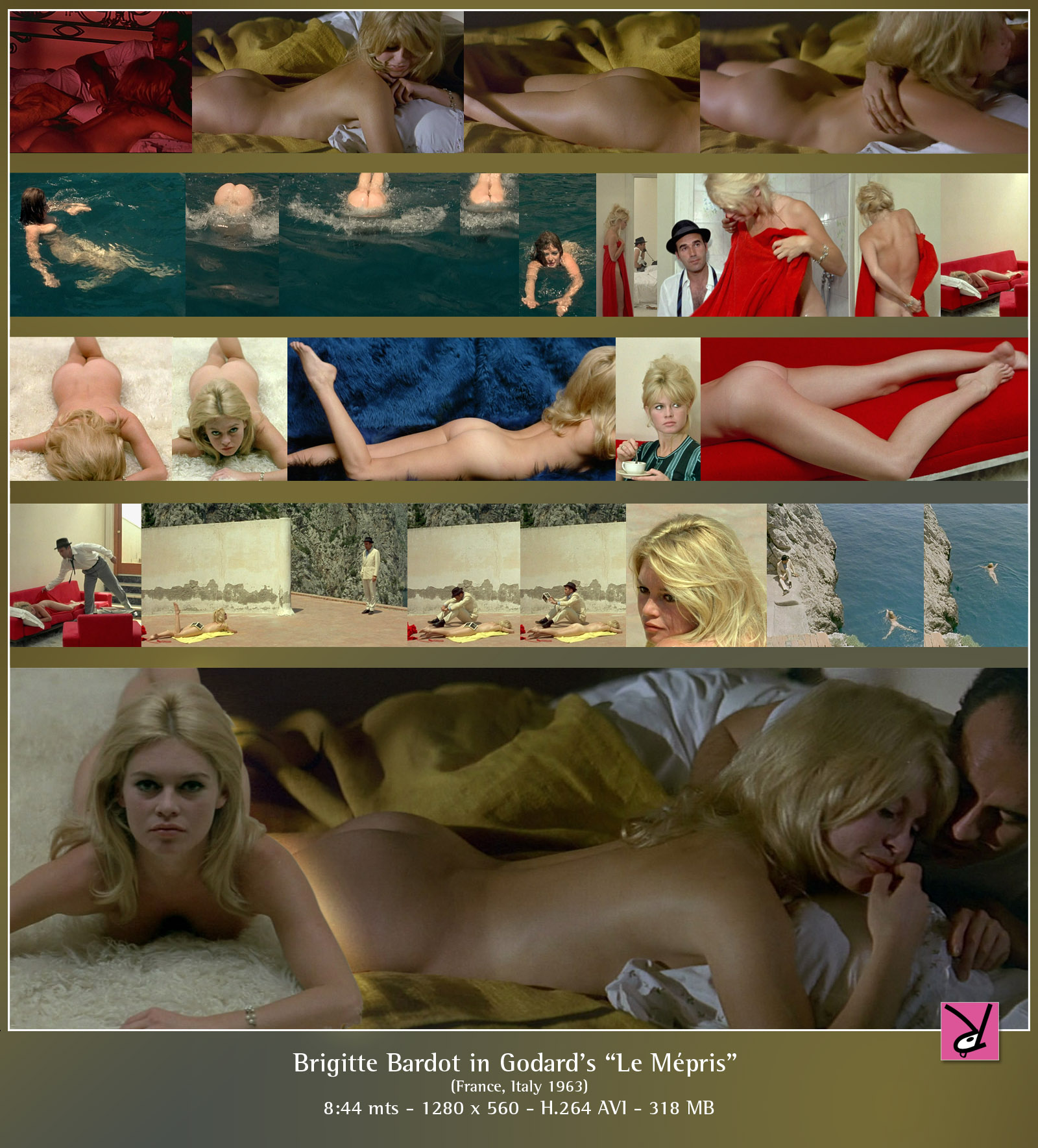
Brigitte Bardot in Jean-Luc Godard’s “Le Mépris” BR720 [1963, France, Italy]

It’s Nouvelle Vague time..!

Jean-Luc Godard had wanted to do a film with Brigitte Bardot for a while, and when his first choice actress Kim Novak turned down the role for his new Franco-Italian production “Le Mépris” [Eng. Title: Contempt], an opportunity presented itself for his wish to come true. Brigitte Bardot was after all the most sought after among sex kittens by auteur directors, undoubtedly the best actress among her kind.

Brigitte Bardot was already a seasoned actress with a decade’s experience under spotlight and a world celebrity, while Godard wasn’t yet widely known beyond French New Wave devotees and of course his home country. This film would make him more widely known, not so much for its artistic merit, as discerning as it might be, but for Mlle. Bardot’s presence in it, in colour, in CinemaScope, and occasionally in the buff to top it all up – who says nudity can’t sell! Ironically Godard hated the novel and the script and couldn’t wait to get the film out of the way. That doesn’t mean he didn’t bother to apply his genius, rest assured no detail was spared, expenses included – after all the film also stars none other than one of the granddads of cinema, the German-born director Fritz Lang (remember Metropolis) – Godard certainly can’t be seen to be slacking here – and that’s some pressure! As it turned out, while this may not be Godard’s finest film (oh I hated the story too), it is interesting nevertheless because it’s something totally different from his otherwise avant garde filmography – we get to see him making a mainstream film at last. But that doesn’t mean he foregoes his trademark symbolism – far from it – it’s there in many a nook and corner if you care to look for it, right from the compositions to the colour palette, the seemingly pointless musings which can initially go past your head but return with vengeance upon reflection, and his ironic sense of humour. It is a fine, stylish film in its own right, even if it’s an atypical ‘Godard’. Those who’ve yet to get acquainted with his work can easily start here, and those who have, can see a different side of him here. Needless to say, Highly Recommended Viewing..!

Storyline:
Playwright Paul (Michel Piccoli) has been commissioned to write the script for Hollywood producer Jeremy (Jack Palance) halfway through making his cinematic version of Homer’s Odyssey. The film is directed by Fritz Lang (as himself) and Jeremy isn’t liking the way it is shaping up. But when they meet, Jeremy couldn’t help noticing Paul’s attractive wife Camille (Briggite Bardot), and the rich and powerful magnate tries everything at his disposal to entice her. When Paul pretends not to notice Jeremy’s infatuation for his wife and tacitly even encourages Camille to accompany Jeremy when asked, a rift opens in the husband-wife relationship. Paul only hoped it would placate Jeremy and enable him to complete the juicy project which could potentially pay off his mortgage, but he never envisioned this could lead to Camille loathing and wanting to leave him. For the best part of the film, the couple are arguing and hurting each other verbally as their relationship breaks apart in front of our eyes. The idealist Paul begins to equate the protagonist of the film he’s writing – Ulysses – as someone like himself, forced to wander the Aegean for ten years even after the battle had ended. According to his theory, Ulysses avoided returning to Penelope because she had already stopped loving him before he originally set sail…

Even though I own the DVD which would suit Godard fans the most for its generous interview extras, I also recommend the recent Blu-ray release of this film – sunny Capri from the 60’s and gorgeous Bardot’s curves come out in striking detail in this exceedingly well restored version.

Amazon Blu-ray Link


The Nudity: Brigitte Bardot and Linda Veras

Briggitte Bardot in Jean-Luc Godard's "Le Mépris"

Brigitte Bardot presents herself in colour, and CinemaScope,
in Jean-Luc Godard’s first commercially successful film, “Le Mépris”.


Scene Guide:

  • The film practically starts with a naked Camille asking Paul for reassurance that he really liked her various body parts. It is a silly lengthy scene probably inserted at the insistence of the film’s financiers – an excuse to show Brigget Bardot who plays Camille in the nude…
  • A bemused Jeremy watches some takes by Lang for his film – this is the scene of a mermaid apparently enticing sailors to their doom at sea. The Sirena is reportedly played by Linda Veras (according to IMDB).
  • Several little scenes – of a long and protruded argument between Paul and Camille, first at their home, and later at Jeremy’s villa by the sea. Towards the end, Camille swims off bidding Paul farewell, that leaves Paul devastated.

.

Continue reading

Posted in Brigitte Bardot, France, Jean-Luc Godard | Tagged , , , , , , | 6 Comments