Valeria Golino in “Il Sole Nero” [2007 Italy]

“Il Sole Nero” [Eng. Title: Black Sun] is the only film I’ve seen so far from much awarded Polish Director Krzysztof Zanussi, so am ill-equipped to write anything about his filmography for the moment. I’ll therefore restrict myself to writing about this Italian film for its own sake.

Storyline:
Agata and Manfredi are a newly married Sicilian couple. Manfredi is younger by close to ten years, but they’re both in love. And Agata is already planning for a child, but Manfredi prefers having her all to himself for some more time before becoming a family. When Manfredi is murdered, Agata’s behaviour undergoes a change that worries her psychologist and authorities investigating the murder. Her love for Manfredi turns into something approaching religious faith – she sometimes has visions of him beside her and even talks to him. But she hasn’t altogether taken leave of her senses either – she wants to find the murderer and ask him why he did it, before she could decide her destiny…

This is a strange film – it’s an attempted neo-noire with elements of melodrama thrown in. I think it is the melodramatic elements that spoil the film, particularly the ending, which could have been a bit more imaginative. But technically this film is well made – notably in its production design. The radiant cinematography and lighting uses warm colours in keeping with the film’s concept. As for the screenplay and characterisation however, it lacks depth, and some of the casting choices don’t help matters. The gorgeous Valeria Golino nevertheless gives a sincere performance, and it is purely for her that I would  recommend this film. I’d like to believe that Mr. Zanussi had done better films, and I look forward to exploring more of his work.

Amazon.it DVD Link


.

Continue reading

Posted in Italian Cinema, Valeria Golino | Tagged , , , , , | Leave a comment

Liv Ullmann in Bergman’s “Skammen” [1968 Sweden]

The late sixties were momentous times in Europe and the world over, and Ingmar Bergman had a message to tell. He needed to tell us of our collective shame – the shame in the way people are governed, wars waged supposedly on their behalf, and the shame of common peoples’ lives devastated by careless decisions made behind those closed doors of power. Do we have to live in such a society, Bergman pertinently asks through his achingly beautiful film, “Skammen” [Eng. Title: Shame].

Vietnam was just one of the theatres of wars waged around the world at the time the film was made, and apart from the blissfully ignorant (who unfortunately number many), few held any real hope for a peacefully coexisting world. Dehumanising images were regularly beamed across TV sets and splashed on magazines, and Bergman was desperate to tell us how these essentially meaningless wars impact ordinary people. With this premise, Bergman creates a complex clockwork of events and characters whose mechanisation will guide the protagonists’ behaviour, likening them to the hands of a clock – unable to change their destiny on their own. But this film is sadly even more relevant today, because we continue to repeat mistakes we’d hitherto sworn to reject, as though mutual destruction has become ingrained in our genes and we can’t help ourselves killing each other.

Storyline:
Jan and Eva Rosenberg are musicians who’ve retreated to an island after the orchestra they were working with dissolved. There’s been a war raging for over four years, and Jan and Eva have even forgotten what the war was all about. But then it suddenly arrives at their very own doorstep. Jan, an idealist, is self-centred and timid by nature, totally indisposed to confrontation of any type. Eva on the other hand, despite being deeply troubled by what’s happening around her, is dedicated to her husband, and dearly likes to mother a child, one that Jan isn’t too keen on. But she is also the one with initiative – the leader of the family. One day their farm is captured by the advancing ‘enemy’, who will then interview the couple and manipulate their words in order to make them sound as though they’re sympathetic to their cause. But soon the enemy is forced to retreat, and the local generals look upon the couple as possible collaborators, and they’re only saved from concentration camp by the intervention of their local Mayor. But the couple will realise the price for his kindness, after he starts frequenting their home with the aim of winning Eva’s favour. Their plight and the film’s message could be summed up in Eva’s prophetic words to Jan during a scene, “Jan, Sometimes everything seems just like a dream. It is not my dream but somebody else’s that I have to participate in. What would happen when the one who dreamt us wakes up and feels ashamed..?”

About the film:
Bergman made this film with a very tight budget, but it hardly shows. It may not have the grand scenes of a “Saving Private Ryan”, but the horrors of war and its psychological impact on people is illustrated quite magnificently nevertheless – it may be intensely bleak, but that shouldn’t put anyone off watching this gem of a film – it is cinema of the finest kind. With the superlative cinematography by Bergman-regular Sven Nykvist and sharp editing by Ulla Ryghe, not to mention the fine performances by his regular actors – Max von Sydow as Jan, Liv Ullmann as Eva, and Gunnar Björnstrand as the Mayor/Colonel, Ingmar Bergman has created another masterpiece that he should be anything but ashamed of. This beautifully crafted film is Highly Recommended Viewing..!


Amazon DVD Link

About the DVD:
This NTSC DVD is my recommended version, as it is a great transfer in its original aspect ratio, and is loaded with extras such as a Bergman featurette titled “Search for Humanity”, an on-camera interview with Liv Ullmann, and an audio commentary in English by Bergman biographer Marc Gervais.


A Masterclass!
Ingmar Bergman is noted for his exquisite compositions, and his films are a pleasure to watch even purely for the manner in which he frames his shots – any designer/artist/film maker will know what I’m talking about. Just take a look at this beautiful scene where Eva and Jan talk about their plans for the future. Liv Ullmann is captivating as it is, but here she is made impossible to look away from, thanks largely to the way this scene is framed. Besides, another interesting aspect of this scene is that it is improvised – the dialogues were made up by the actors themselves, quite rare an occurrence for a Bergman film. I’ve left the subtitles on so you can follow what’s going on.

[stream flv=x:/thirstyrabbit.net/wp-content/uploads/2012/07/Bergman-TR-masterclass-in-framing.flv img=x:/thirstyrabbit.net/wp-content/uploads/2012/07/Bergman-TR-masterclass-in-framing.jpg embed=false share=false width=512 height=382 dock=true controlbar=over bandwidth=high autostart=false /]

Liv Ullmann:
One of the most beautiful and elegant actresses in cinema, Liv Ullmann is as talented as she is insightful in the manner in which she delves into her character. Ms. Ullmann also considers this film to be her personal favourite among all her cine projects with Bergman, partly because the film tackles a subject dear to her – her dislike of war. She was also a spokesperson for UNESCO and had travelled to most of the world’s hot-spots to propagate her message. In personal life, she was also partner to Ingmar Bergman when this film was made, and through whom she even bore a child. She holds Bergman in the highest esteem, and likewise I too hope to discuss more of her films in this blog.


.

Scene: Liv Ullmann
This happens at the very beginning of the film where the audience are introduced to Jan and Eva. Jan, a difficult and unsympathetic character is very well portrayed by Max von Sydow, and Eva is played by the magnificent and stunning Liv Ullmann. And she is stunning as ever even today!

Liv Ullmann in Skammen

The beautiful and exquisite Liv Ullmann considers her performance in one of Ingar Bergman’s masterpieces “Skammen” aka “Shame” as one of her personal favourites.

.

Continue reading

Posted in Ingmar Bergman, Liv Ullmann, Sweden | Tagged , , , | 1 Comment

Petra Schmidt-Schaller in “Sommer in Orange” [2011 Germany]

Marcus Hausham Rosenmüller’s “Sommer in Orange” [Eng. Title: My Life in Orange] is a breezy little comedy of clashing cultures.

Set in the early eighties, the film is about a commune of the Bhagwan Rajneesh cult establishing itself in an idyllic Bavarian village right in the Christian heartland of Germany. It depicts a traditional community coming to terms with the newly arrived ‘devil worshippers’, and their various attempts to have them removed until both of them learn the art of coexistence.

Storyline:
Young Lili and little brother Fabian join mum Amrita and her fellow cult members at a villa recently bequeathed to Amrita’s boyfriend Siddharta. They decide to set-up a commune there much to the dismay of old-fashioned locals, who look upon them with suspicion. But importantly for Lili, she finds it hard being accepted by local kids for who she is, despite her desire to belong. She goes to various lengths, foregoing her orange cult-robes in order to blend in. Neither does her self-centred mother Amrita’s ‘spiritual’ obsession help Lili, who will begin feeling embarrassed about even belonging to the commune. You have drama towards the end when Lili, out of anger wrongly implicates the commune of several crimes including sympathising with the RAF, but she will receive guidance from a rather unexpected quarter that will help smooth some of the cracks that have appeared in the commune, and infuse back some good ‘energy’.

This is a delightful comedy that consistently stays clear of clichés and observes the clash of cultures and their idiosyncrasies without taking them too seriously. The kids playing Lili (Amber Bongard) and Fabian (Bela Baumann) are a treat to watch, they’re the ones who make the film tick. Technically the film is very well made, but like most mainstream films, don’t expect anything too deep. It is nevertheless an above average comedy that’s Recommended Viewing!

Amazon.de DVD Link


.

Continue reading

Posted in Germany | Tagged , , , , | Leave a comment

Antonia Zegers in “Post Mortem” [2010 Chile]

I’ve only recently discovered young Chilean director Pablo Larrain, but can readily see he is set for greater things. He breaks away from the typical Latin American mould to fluidly incorporate stylistic elements from other cinema particularly from northern Europe, and his visuals and pace could very well be mistaken for a Michael Haneke or Thomas Winterberg were it not for his films’ explicitly political and Chilean subject matter.

Larrain’s excellent drama “Post Mortem” is set against Chile’s most momentous and infamous event in its recent history, the 1973 coup d’état that overthrew an elected left-wing government and eventually brought Gen. Augusto Pinochet to power. Cleverly using that backdrop to highlight an apolitical protagonists’ silent despair, it observes how desperate people act and react to certain circumstances.

Storyline:
Mario is a middle-aged civil servant, a recorder at a government hospital morgue. He is also a singleton with old fashioned beliefs, and spurns advances from a female colleague because he believes she is sleeping around. But for all his high morals, he couldn’t help falling in love with neighbour Nancy, a thirty-something performer at a burlesque club, despite knowing she already has a boyfriend, and perhaps several other men whom she may need to please in order to get by. But Nancy, an anorexic and having issues of her own, is non-committal and only willing to offer him the occasional sexual relief. Her father is a member of the communist party, and her house frequently becomes a political meeting place among colleagues. But when the military stage a coup, Nancy’s father and brother are taken away, and she ends up living in a disused store room at the back of her house. Mario brings her food and a radio. But soon, Mario will be recording Nancy’s autopsy…

One of the notable aspects of the film is its cinematography which has a distinct dogme 95 feel about it, unusual frame aspect notwithstanding. But it works brilliantly here, especially during the long penultimate scene where we don’t get to see a face – just the act of furniture being piled on top of each other. The film is slow but adequately paced, and the only music I remember is during the end credits. The performances by main actors, Alfredo Castro who plays Mario, and Antonia Zegers who plays Nancy are suitably subdued for the tone of the film. It may be mildly amusing in some scenes you wouldn’t expect, but is nevertheless an unsettling film that convey’s the message quite eloquently – Highly Recommended Viewing..!

Amazon.com DVD Link


.

Continue reading

Posted in Chile, Pablo Larrain | Tagged , , , , | 3 Comments

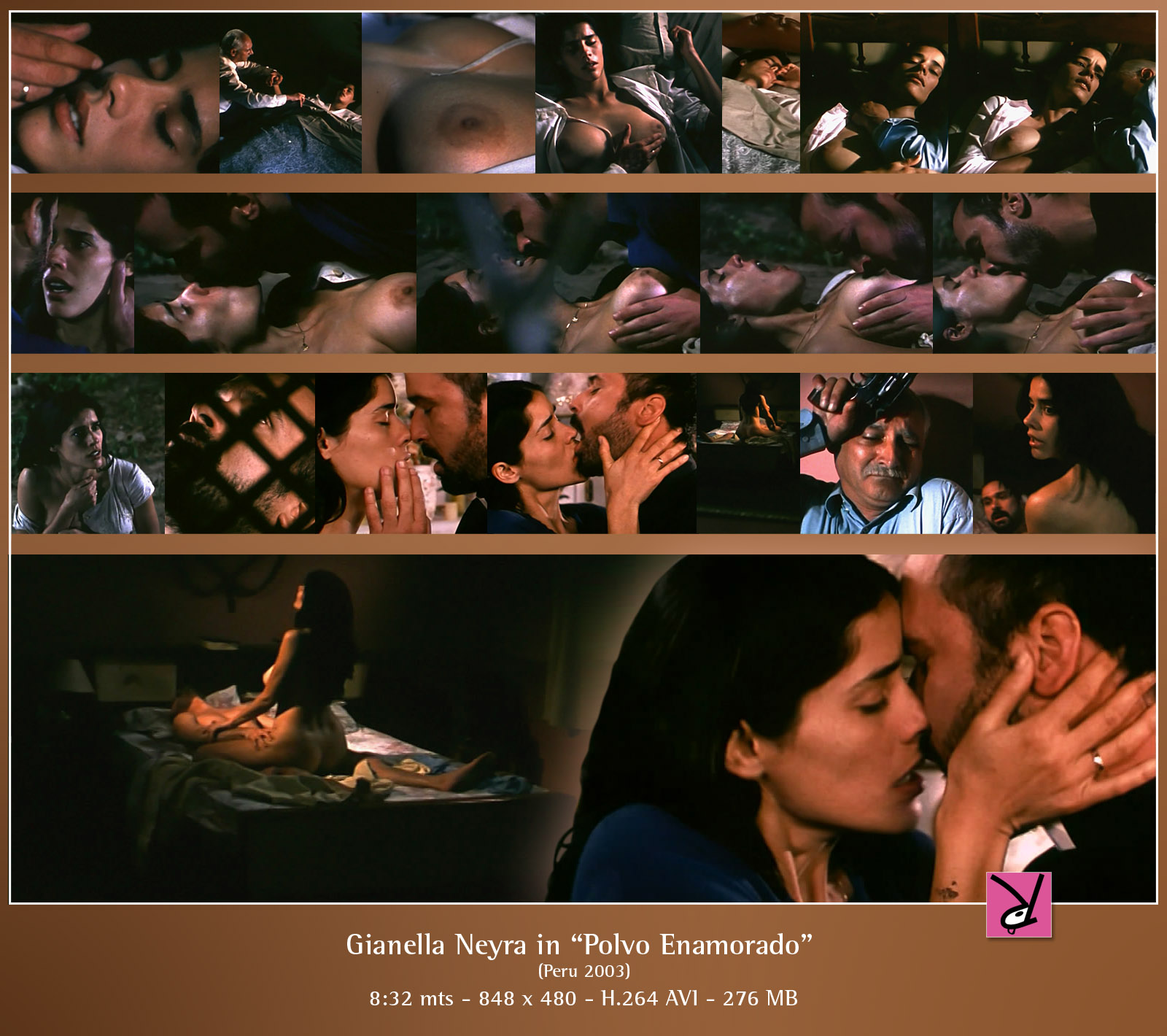
Gianella Neyra in “Polvo Enamorado” [2003 Peru]

“Polvo Enamorado” appears to have been Peruvian director Luis Barrios’ only feature film. Since I haven’t seen any of his TV dramas, this film is my only point of comparison.

Storyline:
Natalia who had wanted to enter a convent is instead given away in marriage to Matías, mayor of a small fishing village, on condition that they don’t consummate their marriage. But middle-aged Matías couldn’t help desiring her sexually, and he drugs her every night in order to touch and fondle her. And it appears that his son from a previous marriage, Percy also fancies Natalia, but doesn’t make any moves due to respect for his father. Matías is actively involved in protecting the interest of his citizens, and in the process incurs the wrath of a large fishing company using trawlers. Meanwhile, new priest Santiago arrives to take over church services, and Natalia finds herself being irresistibly attracted to him. She soon foregoes any intention of joining the convent and instead seduces Santiago to embark on a secret affair. After one of their indiscreet moments is witnessed by Percy, he wastes no time in reporting the incident to his father, which sets off a chain of events…

While part of the storyline is reminiscent of a more famous Mexican film (Il Crimen del Padre Amaro), it unfortunately doesn’t reach anywhere near that film in terms of direction and cinematography – it is filmed pretty much like a TV melodrama and doesn’t aspire to anything special. And I hate to admit – the only reason I purchased this DVD was for the depiction of a sex scene quite rare for conservative Peru – between Gianella Neyra and Paul Vega. I’m afraid there is little else here to write about. But here’s the DVD link for those interested:

Amazon.com DVD Link


The Nudity: Gianella Neyra

Gianella Neyra in Polvo Enamorado

Luis Barrios’ Peruvian melodrama “Polvo Enamorado” will probably be remembered more for the unusually intense scenes between Gianella Neyra and Paul Vega.

Scene Guide:

  • Matías could only look at wife Natalia naked after drugging her. Natalia is played by Gianella Neyra.
  • As it happens, he gets found out one day, much to his wife’s dismay.
  • Natalia connects with newly arrived priest Santiago and despite his initial reluctance, they embark on a secret affair.
  • They will soon be caught in the act by Natalia’s husband Matías

.

Continue reading

Posted in Peru | Tagged , , , , | 3 Comments