Cecilia Roth in “Arrebato” [1980 Spain]

I don’t know much about Iván Zulueta, but his film, “Arrebato” [Eng. Title: Rapture] is one of the best films ever made about cinema – more so about the creative process itself wherein the filmmaker is consumed by his own work. The style is reminiscent of French films from the ‘Nouvelle Vague’ era. If I have to sum it in one word though – it’ll have to be “intense”.

Pedro, an eccentric amateur filmmaker meets established director José through a mutual acquaintance and shows him some of his homemade films. He is restless and loathes what he’s been making so far, until he stumbled upon a time-lapse technique which he’s only eager to share with others. José, who’s going through a personal and creative crisis of his own, is intrigued – and Pedro’s obsession becomes his, and together they literally get ‘sucked-into’ a bizarre trip by the 8mm film camera that Pedro uses for filming. Is this happening for real, or is it just another hallucination from their acid trips..?

This is an obscure little gem worth seeking for true lovers of cinema. I first saw this film several years ago, but was lucky to get hold of a DVD more recently. The quality isn’t particularly pristine – the letter-boxed transfer is dark and grainy, but in a way it adds to the overall claustrophobic atmosphere. I couldn’t enhance any of the scenes in this compilation, and therefore left the resolution from the DVD more or less intact.


 
.
Continue reading

Posted in Cecilia Roth, Spain | Tagged , , , , | Leave a comment

Yoima Valdés & co in “800 Balas” [2002 Spain]

Álex de la Iglesia is largely known for his comedy thrillers and among them, “800 Balas” [Eng. Title: 800 Bullets] remains my favourite. The film is Iglesia’s ode to spaghetti westerns as much as to some unsung talents in the film industry – the stunt men who take that spectacular fall on behalf of the star, but rarely get any recognition.

Young Carlos learns from his grandma that about a grandfather called Julián living in Almeria, who along with Carlos’ father (dead after an accident) performed stunts for spaghetti westerns during its heyday. These days, Julián performs mock-stunts in the decrepit old sets in order to keep things going. Carlos wants to visit him, but his mother still hates the old man, blaming him for her husband’s death. During a school trip to a ski camp, he sneaks out of the bus and heads to Almeria, ski gear et al. Julián, surprised to see Carlos in his ranch, allows him to stay after telling him off for visiting without his mother’s knowledge. Carlos has a great time there, but when the angry mother discovers his whereabouts, she tries to shut the ranch down to build a theme park in its place. Julián finds he has a fight in his hands, this time for real, if he is to keep his job and way of life.

Right from the opening credits and music, to the cinematography, the film aptly pays tribute to spaghetti westerns. Aided by some playful editing and an interesting soundtrack, the it is also entertaining, and the witty dialogues and bevy of pretty actresses make the film truly enjoyable. Needless to say, Recommended Viewing..!

Amazon DVD Link [PAL]


The Nudity: Yoima Valdés and others
A couple of scenes – Julián is rewarded free time with the girls ‘on the house’ with a newly arrived Cuban beauty Sandra, but he’s also tired after a long day, and begs a naked Sandra not to tell anyone that he went to sleep without having sex with her. Sandra, wearing nothing more than the sweetest of smiles is played by the pretty Yoima Valdés. In another scene, she gives some hands-on instructions about groping to a bemused and very lucky Carlos.

Yoima Valdés nude in 800 balas aka 800 Bullets

Gorgeous Yoima Valdés is all smiles and nude in Álex de la Iglesia’s comedy thriller
“800 balas” aka “800 Bullets”.

.

Continue reading

Posted in Álex de la Iglesia, Spain | Tagged , , , , , , | Leave a comment

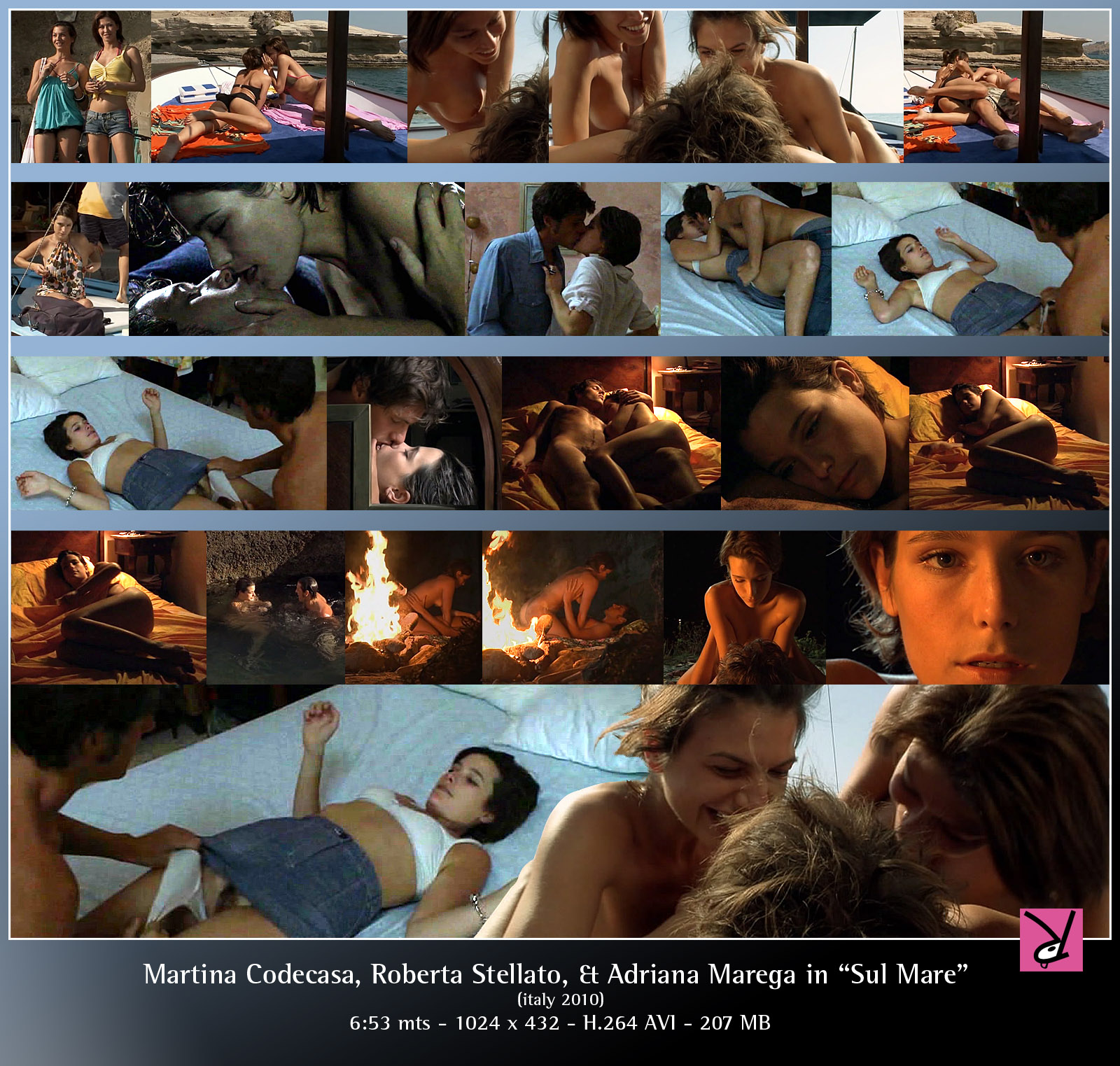
Martina Codecasa & co in “Sul Mare” [2010 Italy]

Alessandro D’Alatri’s recent Italian film, “Sul Mare” [Eng. Trans: At Sea] is an old fashioned bitter-sweet romance set in a Neapolitan island. It’s the story of Salvatore, a happy-go-lucky lad whose life seems to have been neatly split into two halves – during the summer, he makes a living by hiring his boat to tourists, and during off-season, works at a construction site in the mainland. Until he meets Martina, a Genoese lass and scuba diving enthusiast. He falls madly in love with her, an experience which will nevertheless teach him some hard truths of life.

The film is well conceived, with a well-written script and neat direction. It has a straightforward narrative, and the main cast give a decent-enough performance to make the film tick, particularly the young actress playing her namesake, Martina Codecasa. Fine cinematography is aided by some breathtaking locales, and pleasant music. But the film is also a notch above your average light entertainment – it is actually quite moving at times, and therefore definitely Worth Viewing.


The Nudity: Martina Codecasa, Roberta Stellato, and Adriana Marega
The film contains several brief flashes of nudity in an otherwise ‘strictly mainstream’ production.

Martina Codecasa and Adriana Marega play fun-seeking tourists, and beautiful Martina Codecasa the girl who breaks Salvatore’s heart in “Sul Mare”.

.

Continue reading

Posted in Italian Cinema | Tagged , , , | Leave a comment

Mariangela Melato & Sandra Julien in Claude Chabrol’s “Nada” [1974 France]

It’s Nouvelle Vague time – I’ll start Claude Chabrol’s filmography with one of his lesser known films, “Nada” [Eng. Title: The Nada Gang], a crime thriller centred around a fictitious anarchist group who called themselves N.A.D.A.

This isn’t your typical Chabrol – I was just lucky to have found it in one of my excellent box-sets. It is also not my favourite Chabrol, but I loved it nevertheless for its wit and satire. The fact that it also stars the classy Mariangela Melato, one of my favourite Italian actresses came as a pleasant surprise.

Claude Chabrol, one of the pioneers of the French New Wave cinema movement, is broadly compared to Hitchcock for his early suspense thrillers. But where he differs is by also giving social commentaries through his films, sometimes even taking precedence over the plot. He was a prolific filmmaker, and inevitably went through several phases of mediocrity and brilliance. But there’s no denying the fact that whenever you think of legendary actresses like Stéphane Audran, Romy Schneider, and Isabelle Huppert, it is likely to be for one of their films directed by Claude Chabrol.

Synopsis:
Nada Gang members, led by academic Marcel kidnap the American ambassador for a ransom, but things take a different turn when the home ministry and an over-zealous superintendent decide to make an example out of them. Chabrol gives us a cynical insight into the way politics work, and also how even idealists compromise when the need arises. This is not exactly a great film, but certainly enjoyable as an action-packed crime drama. Besides, we also have some accidental nudity from Mariangela Melato who plays gang member Veronique, and a wholesome nude scene from pretty Sandra Julien who makes an appearance as a prostitute.


Continue reading

Posted in Claude Chabrol, France, Mariangela Melato | Tagged , , , , , , | Leave a comment

Pilar López de Ayala & Manuela Arcuri in “Juana la Loca” [2001 Spain]

Vicente Aranda’s “Juana la Loca” [Eng. Trans: Juana the Mad, Eng. Title: Mad Love], was the first of three period pieces he made in succession – the other two – “Tirante el Blanco” and “Carmen” are already featured here. It is also the best of the three, aided by an impeccable performance from Pilar López de Ayala, the actress who plays Juana, the unfortunate queen of Castile and daughter of Ferdinand and Isabella.

Based on a play, the film begins her story about four years after the new world discoveries, when sixteen year old Juana is sent off to Flanders to marry Philip of Burgundy to formalise a political alliance. The marriage however turns out to be a failure, for despite Juana being ‘madly’ in love with husband Philip, he was more interested in nothing more than usurping her power. Her father Ferdinand too conspires to restrict her powers, and rumours are circulated of Juana’s presumed insanity, questioning her fitness to govern. She’s confined in a convent for the next forty seven years, and remained queen in name only until her death. There are several major events covered in the film which I’ve skimming past – those interested can use this link to explore more of Juana’s story.

Needless to say, the film has pretty high production values, especially the costumes, set design and art direction. Just as impressive is the cinematography, direction and editing. The film was nominated for no less than twelve Goya awards the following year, of which it bagged three. Recommended Viewing.


.
Continue reading

Posted in Spain, Vicente Aranda | Tagged , , , , , | 1 Comment