Evangelina Sosa in “Ángel de Fuego” [1992 Mexico]

Dana Rotberg hasn’t made that many feature films, and I keep wondering why. She is one of the most gifted female directors today, and I say this with conviction even if I have seen only two of her three features to date (the other one being Otilia Rauda). Her drama, “Ángel de Fuego” [Eng. Title: Angel of Fire] was made nearly twenty years ago – a heartfelt critique of the duplicitous nature of religion – claiming to redeem people from suffering on the one hand, while unforgiving and vicious on the other.

It is a passionate plea for tolerance and understanding, for reason to prevail over dogma. Set amongst the mundane and unattractive backdrop of an industrial rail yard on the impoverished outskirts of Mexico city, Rotberg has created haunting compositions that confronts and forces viewers out of their complacency. What the film is trying to tell may not be totally unique, but it is the manner in which it conveys the message that leave us speechless. It must have been tough making such a film at the time when Mexico wasn’t yet a modern democracy. It is nevertheless a relentlessly unforgiving film – the first part would’ve put many people off, where a young acrobat has incestuous relations with her ailing father – it is shocking but handled delicately, considering the circumstances under which this happens. Some may also be put off by the catastrophic ending, but the bulk of the film however is all about redemption and salvation, asking pertinent questions like “when is love a sin”, “doesn’t God forgive all those who love” and so on. To the end we’re left asking, who is the sinner in all this that require any redemption.

The film uses exquisite folk imagery like puppets, kitsch backdrops, and local beliefs to avidly capture the essence of a different, but altogether real Mexico. It speaks to me in so many levels, and it is also one of the socially important films to have come out of this fascinating country. It’s hard to believe Dana Rotberg hasn’t made many more films, she is one of her country’s hidden treasures that should be more widely celebrated.

The characterisation and screenplay is well thought out, as is the delicate direction and cinematography. The soundtrack is haunting with a mixture of folk rhythms interspersed with sounds from nearby industry and distant barking (a symbol of human presence). Not least the magnetic performance of the beautiful Evangelina Sosa, who plays the melancholic and angelic Alma, a thirteen year old acrobat and fire breather using the titular name at a dilapidated circus. This is a gem of a film, and therefore without a doubt, Highly Recommended Viewing..!

Recommended Amazon.com DVD Link
(there are some good deals going there at the time of this post)


I felt compelled to enhance this compilation as the DVD was stamped predominantly for older television sets. Here’s a snapshot from the original DVD (left), and my enhanced version (right).
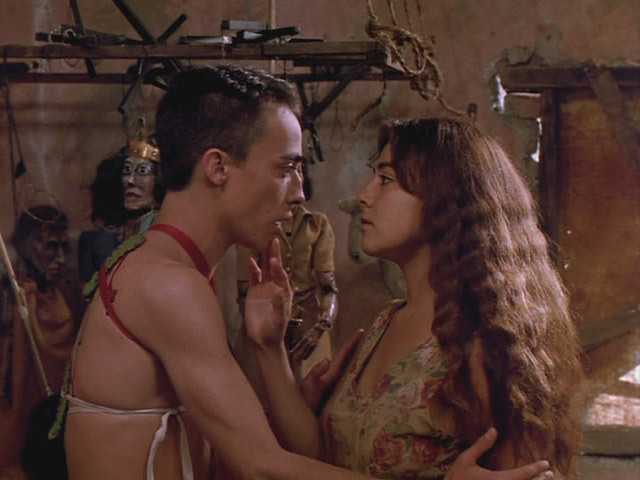
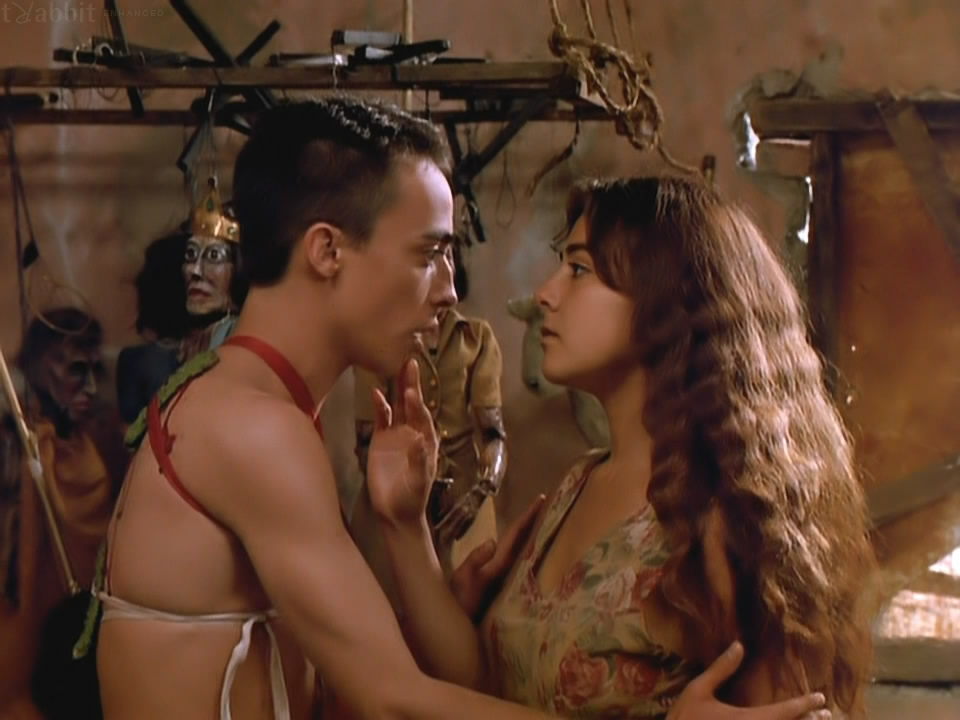
From the original DVD snapshot of enhanced version

.
Continue reading

Posted in Dana Rotberg, Mexico | Tagged , , , , , , | 4 Comments

Mar Ulldemolins & Alícia Roy in “Mil Cretins” [2011 Spain]

Veteran Catalan director Ventura Pons is known for films with unusual characters (oddities almost), dark humour and kinky themes of a vicarious nature. He may have mellowed over the years, but his films still retain a refreshing frankness that’s rare these days. Of course, Cataluña is renowned for its quirky artists (and that is an understatement), and it is only natural to see quirkiness manifested in its rich cinema too.

His recent film, “Mil Cretinos” [Orig Title: Mil Cretins, Eng Title: A Thousand Fools] is made of three parts, each with several chapters loosely connected either through one of the characters or an overall theme, a style of film making Sr. Pons has used more than once.

The first and third parts are set around an old people’s home, and inevitably casts a pall over its characters – whether it is a family member about to die, or the end of a relationship. The second part is almost Decamerotic, even if these are staged as theatrical pieces, all chapters taken from folk and fairy tales but with either the roles reversed or with twisted endings. If you can sit through the first two chapters of the film, you’ll begin to enjoy the rest. Having said that, I found one chapter particularly tedious where we follow a mature woman stripping her apartment of all belongings one by one with barely a dialogue or commentary – it may have worked well for a novella but perhaps not so on film. The soundtrack and cinematography is appealing, even if it’s not exactly cutting-edge. While the film may not be in the same league as his earlier gems like “Carisias” or “El Porqué de las Cosas”, it is still very well written, directed and performed by established actors.

Amazon Ventura Pons 2-DVD Box-set


.
Continue reading

Posted in Spain, Ventura Pons | Tagged , , , , , , , , | 3 Comments

Juliette Binoche in “Rendez-vous” [1985 France]

It’s about time I started the filmography in this blog of one of France’s most beautiful and talented actresses – Juliette Binoche. I’ll begin with André Téchiné’s romantic drama, “Rendez-vous”, which is Mlle Binoche’s earliest starring role and also features her first nude appearance. And what a grand debut it turned out to be..!

Storyline:
Eighteen year old Nina arrives in Paris with stars in her eyes – she wants to make a name for herself in theatre, and she takes up whatever minor roles she could get to keep her going. Free-spirited, she moves out of her theatre usher boyfriend’s flat and meets letting agent Paulot, who instantly falls in love with her. But she prefers they remain platonic friends and falls for his flatmate Quentin instead. But Quentin has issues – he couldn’t forgive himself for a past tragedy, and transmits his hatred to everyone close to him, to the extent that he wouldn’t leave Nina alone even after he dies. His death unexpectedly acquaints Nina with a director Scrutzler, the father of Quentin’s late girlfriend, who decides to cast her as the main character in his stage play, “Romeo and Juliet”. Nina, who struggles at the beginning to understand the character she’s playing, gradually learns what it is to fall in love, get hurt, and relate to the character she initially found so uninteresting.

This is a beautifully written film by Téchiné. We see glimpses of his brilliance in the manner in which he spins a elegant (and earthy) love story around the film’s main theme, which is about the maturing of a raw actress from the provinces. Just as Nina samples, savours, and absorbs experiences from the people she meets, she begins to understand the character she plays – she begins to also understand and fall, in love. The sights and sounds of Paris, the screenplay, the uncompromising performances by all main actors, and the great ending is what makes this a true French film classic. Add to this, the amazing maturity shown by Juliette Binoche who plays Nina – she was only twenty one at the time – the film gives us a preview of what was to come from this gifted actress. Needless to say, Highly Recommended Viewing..!

Amazon DVD Link


.
Continue reading

Posted in André Téchiné, France, Juliette Binoche | Tagged , , , , , , | 1 Comment

Ana Belén in “La Pasión Turca” [1994 Spain]

Veteran Catalan director Vicente Aranda’s passionate melodrama, “La Pasión Turca” [Eng. Title: Turkish Passion] is probably not the best way to start the filmography of Ana Belén, one of Spain’s important singer-actresses, who was also one of the faces of her country’s ‘Destape’ transition years, when censorship was first relaxed. I fear Sra. Belén may have been terribly miscast in this film. I haven’t read the novel from which it was based, and judging solely by the script and screenplay – I presume the character played by Ana Belén must either be a dumb nymphomaniac or someone with an obsessive dependence on her lover. Against common sense, her character returns to an abusive and overbearing relationship with a lover who can do little else but take. The film also casts a clichéd and outdated view of Islamic society, with undertones that could be considered racist. But then again, this is a film from a different era, and what may be considered unacceptable now may have even been tolerated then.

Technically though, the film is masterfully put together, with some excellent camera work and editing, supported by some sumptuous locations and a fabulous soundtrack. There are some individual words of brilliance here and there (probably from the novel) but on the whole, the script appears to have been compiled in a hurry. The performances are also just about average – may be they didn’t have much to work with. The film had all the ingredients for a passionate Spanish drama – perhaps the chemistry wasn’t right. I’m a great fan of Sr. Aranda’s early films, many of which were quirky and daring, but this is definitely not one of his better works – his best in my opinion was made some ten years earlier (Fanny Pelopaja) which I’ll post in due course.


Storyline:
Newly wed Desideria and Romiro accompany other members of the family on a holiday to Istanbul – she’d been unhappy of late after being diagnosed ‘frigid’ by her gynaecologist. During their stay, she’s drawn to their tourist guide Yaman and instantly embarks on an affair – getting away briefly from family for their quick but passionate sex sessions. People have affairs for various reasons, and it is these variations that make them such a popular film-theme, but what Desideria is seeking through her affair is left unexplained. Upon returning to Spain, she discovers she’s pregnant (some diagnosis, huh!), just when husband Romiro is informed that he’s sterile. Obviously there’s no room to lie, and they decide to keep the child after she promises not to have relations with Yaman anymore.

But after the child dies (cot-death?) Desideria decides to leave her accommodating husband and head back to Turkey, only to discover Yaman’s not only married, but also no longer a tourist guide but a drug trafficker. Just as she’s getting used to the idea of having to be someone’s mistress for the rest of her life, comes a nasty surprise – Yaman now demands she ‘satisfy’ some of his ‘important’ clients too. She runs away humiliated, but returns – enthusiastically having sex with whoever Yaman asks. But after she realises that Yaman too has sex with other clients, she feels betrayed. I really don’t know what to make of this film having seen it thrice over the years, and each time while I tried to look for some subtle nuance I might have missed earlier, I didn’t find any!

Amazon DVD Link


The Nudity: Ana Belén and Laura Maña

Ana Belén and Laura Mañá in La Pasión Turca

The film, “La Pasión Turca” includes several scenes of nudity by Ana Belén and also one by Laura Mañá.

.
Continue reading

Posted in Ana Belén, Spain, Vicente Aranda | Tagged , , , , , | Leave a comment

Alessandra Cantini in “La Prima Cosa Bella” [2010 Italy]

Paolo Virzì has made some interesting films over the years and one thing that stands out is his storytelling. His latest drama, “La Prima Cosa Bella” [Eng. Title: The First Beautiful Thing] is perhaps his finest achievement to date – he and his co-writers Francesco Piccolo and Francesco Bruni also rightly won the David last year. Virzì cast wife Michaela Ramazzotti in the lead role who also won a David for Best Actress, along with an excellent supporting cast including the magnificent Stefania Sandrelli, and Claudia Pandolfi (who should have also won the award for a fine supporting performance).

The film is a sentimental feel-good drama about a mother and her two children spanning three decades. Middle-aged literature professor Bruno recollects events from his childhood while visiting his terminally ill mother at a hospice – he had avoided her and his sister for several years, and the film pieces his reasons together during its course – the narrative is well thought out and laid out beautifully. The upheavals in his family apparently start after she wins a beauty pageant for Young Mothers in the early 70’s. The father gets jealous when a judge kisses her for a photo, and after a nasty argument, she leaves with children in the middle of the night in pouring rain. It is his perception of how his mother made ends meet from then on that shapes his withdrawn personality. But the film also avoids branding its characters as good or bad, instead allowing us to make our own judgements. Some of the scenes are positively touching, like when the ailing mother reaches out to Bruno, and later when he reconciles with his loving sister in a proper one-to-one chat. There’s also great humour in the film to balance things as they become heavy – altogether a well written and performed film for a mainstream audience that also stars Micaela Ramazzotti and Claudia Pandolfi. Recommended Viewing..!

Amazon.it DVD Link


.
Continue reading

Posted in Italian Cinema | Tagged , , , | Leave a comment